A Note about Honey

Honey is, as they say, the nectar of the Gods.  It is an amazingly complex, not to mention delicious substance that has not only pharmacological properties but preservative ones as well.  When I was a child, my mother kept a jar in the cupboard filled with garlic cloves soaking in honey.  The honey kept the cloves from spoiling, and the garlic subtly flavored the honey.  When we had a cough or sore throat, out came the honey pot and in went a teaspoon of the “medicine”, which was both helpful and delicious.  Some people claim that raw honey will alleviate allergy symptoms.  It has anti-microbial, anti-bacterial and anti-biotic properties, and contains several known anti-oxidants.  It has been used topically for thousands of years in the treatment of wounds and ulcers.  As a preservative, honey can keep foods from spoiling for many years if kept in a dry and cool environment such as a root cellar.

We keep two small hives that provide us, on a good year, with several gallons of delicious honey that we use both in the kitchen and as gifts during the holidays.  Family and friends tell us they wait anxiously for Christmas, hoping for a new jar of the sweet nectar for their pantry.    Keeping bees is not difficult to learn.  With a good book and, if you are lucky, the advice of an experienced apiarist, it is fairly easy to purchase everything you need online, including the bees themselves.  Now is the time to order hives and get started for a good honey crop in the fall.  Once the initial investment is made, they don’t take up much space and only require a minimum of time.

Although I believe honey to be a healthful and natural sweetener, it should be always used in moderation.  It is primarily made of simple sugars, and creates an immediate biochemical release of insulin, as well as the resulting “sugar crash”.  Think of our ancestors before the advent of agriculture.  How often did our wandering predecessors come across a hive filled with wild honey?  Use honey as if it were as valuable and precious as gold.  Furthermore, honey is not suitable for infants, as it can contain yeasts and bacterium not suited to the newborn digestive system.   It’s best to buy honey from a local source, preferably wild.  Look for it at your farmers market.  When shopping for honey in a grocery store, look for raw honey that has not been pasteurized or blended.
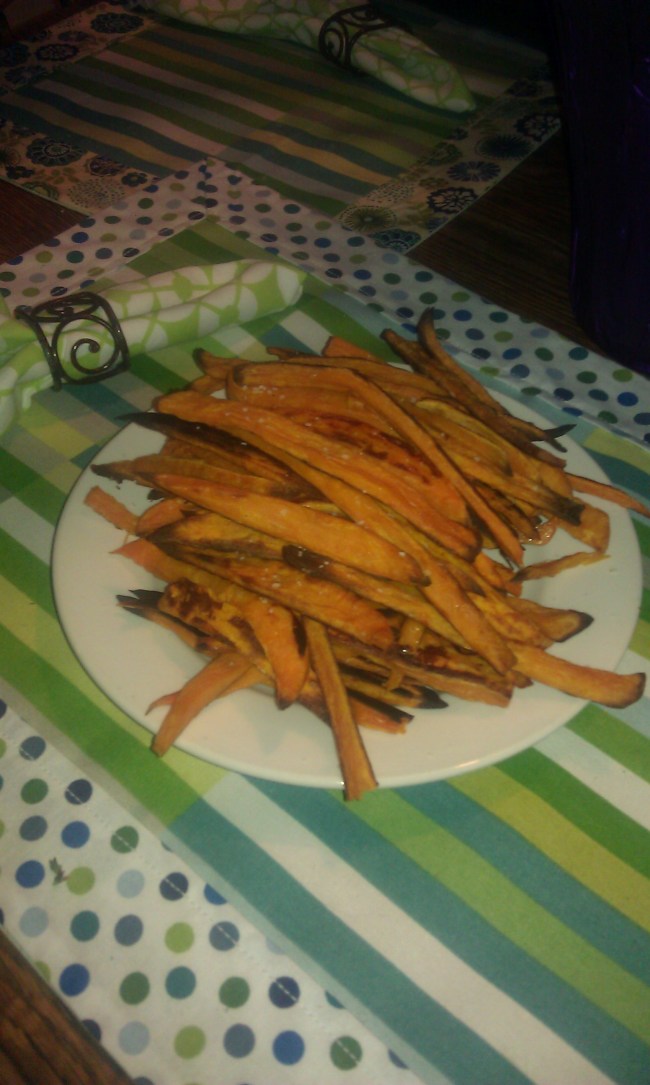
Baked sweet Potato Fries

Spring is a time when we long for the fresh foods of the summer, but mostly we get the washed out veggies from the supermarket that still have the stink of diesel fumes from the miles they have been trucked to us.  Often we resort to complicated meals full of starches to hide our longing for the taste of summer.  Enter center stage…the sweet potato!  The sweet potato is one of natures super foods.  Packed with nutrients, it acts on our blood sugar in a different, better way than regular white potatoes, and it’s sweet, nutty, rich flavor can be like candy on the tongue.  But sadly, the sweet potato is often regulated to the sad state of boiled down mush mixed with heaps of butter and topped with (yuck!) marsh mellow that we call a Thanksgiving dish.  Who can give thanks for that?  Not your digestive system, that’s for sure.

The sweet potato is easy to store.  Kept in a cool place, like a basement or garage it can last for a very long time, especially if it has been dipped in bee’s wax.  It can be seasonal any time!  The sweet potato is easy to grow.  Put it in a trench, cover it over, and dig it up 3, 4, or even 5 months later.  I have eaten sweet potatoes that have been left in the ground over winter and then dug up before they sprouted in the spring.  They are seasonal anytime!  They are also cheap, delicious and, did I say? Packed with nutrients.  So what do we do with the lowly sweet potato to make it shine like a star?  The simplest thing possible.  Bake it with salt and olive oil.

First get as many sweet potatoes as you need to feed your crew.  Sometimes they are giant and one will feed 3, so gauge your guests, but remember….they taste better than you might think, AND they are especially good cold!  So make plenty.  Peal them of their outer skin.

Set the oven to 500F.

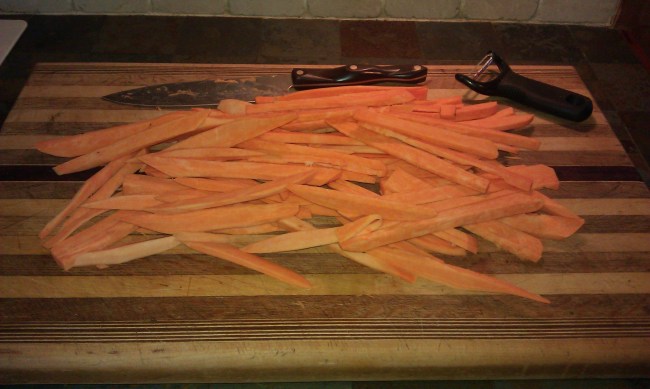
Next, cut them into either wedges or strips.  The thickness will determine the time it takes to bake them.  I like smaller strips, but too narrow and they will burn up.

I made this pile for three of us, with leftovers.

Image

Next, put them in a big bowl and drizzle them with good quality olive oil, and a big pinch of salt.  I always use Morton’s sea salt.  It is thicker ground than regular table salt, and is better for you.  I keep it in a small finger bowl and use my fingers to pinch out how much I need.  A big pinch is about a teaspoon.

Spread the potatoes out evenly on a pan lined with tinfoil.  They tend to stick, and I hate cleanup!

 Image

If you have to, use two pans.  Put them in the 500 oven and cook for a while.  You’ll need to check them regularly because the cooking time depends on the oven and the size of the fries.  If you used two pans, make sure you switch their position in the oven every 5 minutes or so.  Mine took about 20 minutes to cook until they were starting to brown and crispy.  When you take them out of the oven, let them cool a few minutes before putting them in the serving dish.  As they tend to stick, using your fingers to pick them off the tin foil is the easiest, so be careful not to burn yourself!  Next, add a sprinkle of salt and serve!  YUM!Image

Forcing Forcythia

quince sprigs

Even when it seems like spring will never come, there is hope outside if you know where to look.  I love fresh flowers, and the long winter has deprived me of this bit of color in the house. The forsythias are always the first sign that spring is truly on it’s way.    On a day when the wind howls, I can look at my sprigs of forsythia and know that there is no stopping the seasons, even if it feels like the warmth will never come.  I pick them right at the end of February, and with a hammer slightly crush the stems.  In about a week they will be in full bloom, earlier than the ones outside.  Another one of my favorite indicators that sun and warmth are on the way is the tiny shoots of garlic that are pushing up from the half frozen ground in my garden.  In another week the soil should be warm enough for planting peas and parsnips.  I’ve started the lettuce inside this year, and my many hot peppers, started in January, are inches high and looking great.  I also started some basil indoors, which is so easy to grow in a warm window, and that has provided us with a nice bit of fresh flavor for some of the earthier cold weather dishes of the early spring.  This time of year is filled with expectation and planning for gardeners in the North East, and is a wonderful time to rejoice and appreciate that there truly is no stopping nature.

One week later…

IMAG0264.jpg