Baked sweet Potato Fries

Spring is a time when we long for the fresh foods of the summer, but mostly we get the washed out veggies from the supermarket that still have the stink of diesel fumes from the miles they have been trucked to us.  Often we resort to complicated meals full of starches to hide our longing for the taste of summer.  Enter center stage…the sweet potato!  The sweet potato is one of natures super foods.  Packed with nutrients, it acts on our blood sugar in a different, better way than regular white potatoes, and it’s sweet, nutty, rich flavor can be like candy on the tongue.  But sadly, the sweet potato is often regulated to the sad state of boiled down mush mixed with heaps of butter and topped with (yuck!) marsh mellow that we call a Thanksgiving dish.  Who can give thanks for that?  Not your digestive system, that’s for sure.

The sweet potato is easy to store.  Kept in a cool place, like a basement or garage it can last for a very long time, especially if it has been dipped in bee’s wax.  It can be seasonal any time!  The sweet potato is easy to grow.  Put it in a trench, cover it over, and dig it up 3, 4, or even 5 months later.  I have eaten sweet potatoes that have been left in the ground over winter and then dug up before they sprouted in the spring.  They are seasonal anytime!  They are also cheap, delicious and, did I say? Packed with nutrients.  So what do we do with the lowly sweet potato to make it shine like a star?  The simplest thing possible.  Bake it with salt and olive oil.

First get as many sweet potatoes as you need to feed your crew.  Sometimes they are giant and one will feed 3, so gauge your guests, but remember….they taste better than you might think, AND they are especially good cold!  So make plenty.  Peal them of their outer skin.

Set the oven to 500F.

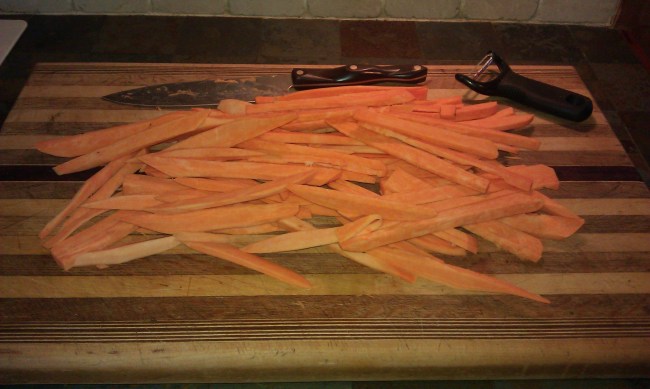
Next, cut them into either wedges or strips.  The thickness will determine the time it takes to bake them.  I like smaller strips, but too narrow and they will burn up.

I made this pile for three of us, with leftovers.
Image

Next, put them in a big bowl and drizzle them with good quality olive oil, and a big pinch of salt.  I always use Morton’s sea salt.  It is thicker ground than regular table salt, and is better for you.  I keep it in a small finger bowl and use my fingers to pinch out how much I need.  A big pinch is about a teaspoon.

Spread the potatoes out evenly on a pan lined with tinfoil.  They tend to stick, and I hate cleanup!

 Image

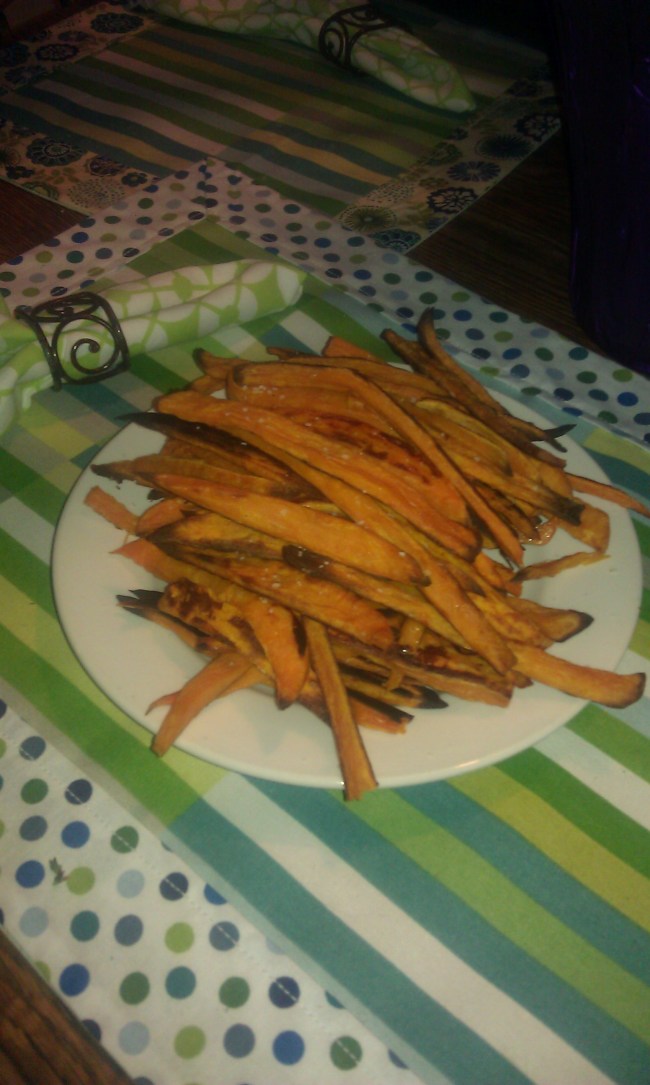
If you have to, use two pans.  Put them in the 500 oven and cook for a while.  You’ll need to check them regularly because the cooking time depends on the oven and the size of the fries.  If you used two pans, make sure you switch their position in the oven every 5 minutes or so.  Mine took about 20 minutes to cook until they were starting to brown and crispy.  When you take them out of the oven, let them cool a few minutes before putting them in the serving dish.  As they tend to stick, using your fingers to pick them off the tin foil is the easiest, so be careful not to burn yourself!  Next, add a sprinkle of salt and serve!  YUM!Image
Forcing Forcythia

quince sprigs

Even when it seems like spring will never come, there is hope outside if you know where to look.  I love fresh flowers, and the long winter has deprived me of this bit of color in the house. The forsythias are always the first sign that spring is truly on it’s way.    On a day when the wind howls, I can look at my sprigs of forsythia and know that there is no stopping the seasons, even if it feels like the warmth will never come.  I pick them right at the end of February, and with a hammer slightly crush the stems.  In about a week they will be in full bloom, earlier than the ones outside.  Another one of my favorite indicators that sun and warmth are on the way is the tiny shoots of garlic that are pushing up from the half frozen ground in my garden.  In another week the soil should be warm enough for planting peas and parsnips.  I’ve started the lettuce inside this year, and my many hot peppers, started in January, are inches high and looking great.  I also started some basil indoors, which is so easy to grow in a warm window, and that has provided us with a nice bit of fresh flavor for some of the earthier cold weather dishes of the early spring.  This time of year is filled with expectation and planning for gardeners in the North East, and is a wonderful time to rejoice and appreciate that there truly is no stopping nature.

One week later…

IMAG0264.jpg

On being a Congregationalist

My mother, like most mothers, and most people for that matter, is one of those people who listens to about half of what I say, then makes up the rest and believes whatever she thinks must be true.  For example, for the last 5 years my husband’s family has had a home on Martha’s Vineyard.  We visit there about 5 times a year, and every time I return from a trip there my mother asks me “How was your trip to Nantucket?”  For the first few years it drove me absolutely mental, and I would vehemently remind her that I had never been to Nantucket and had no plans to go there, ever.  But after a while I just got used to it, and would respond to her questions with “Great Mom, we had a really nice time.”

Last spring, when my mother’s husband passed away, I went down to Florida to help her with the plans for his funeral, which happened to be at a catholic church.  We had a meeting with the director from the church, who asked me if I was a Catholic.  I was about to respond when my mother said to her “Oh no, she’s a Methodist” !  I looked at my mom incredulously.  “Mom” I said, “I’m a Congregationalist.  Big difference”  “Oh, it’s all the same” she replied “All you Christians believe the same thing.” I let it go.  It was my Mom, after all.

But I couldn’t really let it go.  It kept coming back to me that I didn’t like being referred to as a Methodist, but I couldn’t say why.  I mean, we are all Christians, after all.   So I spent some time thinking about it.  What was it about being a Congregationalist that I felt was so important?  I looked up the definition of Congregational in a few dictionaries, and here are some of the definitions I came up with…

“A system of Christian doctrines and ecclesiastical government in which each congregation is self-governing and maintains bonds of faith with other similar local congregations”

“A type of Protestant church organization in which each congregation, or local church, has free control of its own affairs. The underlying principle is that each local congregation has as its head Jesus alone and that the relations of the various congregants are those of fellow members in one common family of God.”

“A form of church governance that is based on the local congregation. Each local congregation is independent and self-supporting, governed by its own members.
With that freedom comes the responsibility upon each member to govern himself or herself under Christ. This requires lay people to exercise great charity and patience in debating issues with one another and to seek the glory and service of God as the foremost consideration in all of their decisions.”

I”n congregationalism, rather uniquely, the church is understood to be a truly voluntary association”.

And finally…

“To a Congregationalist, no abuse of authority is worse than the concentration of all decisive power in the hands of one ruling body.”

Self governing.  Free control over our own affairs.  Independent and self-supporting.  A group united for the purpose of worship.  That means a lot to me.

I’ve recently started studying Mycology.  For those of you that don’t know what that is, like me two weeks ago, it is the study of fungi.  I know I’m being a little divergent here, but bear with me.  Fungi are truly incredible, and I’ve come to realize that the study of fungi is akin to the study of life.  While I won’t bore you with all of the fungal facts I’ve turned up of late, I will tell you that fungi live on every surface, in every organism, and can theoretically live forever.  They are incredibly complex, and function as a shadow immune system, a shadow digestive system and are the source of some of the worst plagues and the best medicine we have.  They are uniquely symbiotic with every living thing on the planet, and are a perfect example of the inter-connectedness of our species to our world.  Everything on earth functions as an ecosystem; in fact, an ecosystem within an ecosystem within an ecosystem.  And each ecosystem, each plant and animal and fungus, is comprised of a complex system of interrelated and coordinated organisms.  In fact, if you think about it, the concept of “Me” is almost obsolete because in reality “Me” is a community.

To some, this may be creepy, but to me, it’s an example of God’s wondrous, unimaginable and endless creativity.  And just as I am a microbiotic community of functioning organisms, we the Church are a macrobiotic community of functioning organisms.  God meant us to be interrelated.  God meant us to be symbiotic.

I read a quote once that I remember.  “Whatever image you are holding in your mind is the reality you will invite into your future”.  This is so true. Furthermore we can create an image of our most desired future to focus on.   We can come together to collaborate and participate in determining our best future.

To sum up, our doctrine is self determination.  We choose our own path.  God meant us to work together.  Only by working together, not just some of us, but all of us collectively, can we determine our path forward.  We are at a time in our Church where we want to, and need to, affirm our best selves, create positive images and determine our future path.  Together we can make a brighter community, and a better world.Image