The speed of life: how we relate to our food.

Time sure flies, doesn’t it?  How did I get this old?  I look in the mirror and am amazed that inside I still feel  twenty six, but outside I look every bit of my forty (uh…) ish years.  And it keeps getting faster and faster.  I’ve satisfactorily explained this phenomenon to myself in terms of a mathematical theory involving ratios. It works like this. The amount of time we have been alive is directly proportional to the speed of time.   So in my head I understand it, but in my heart it’s still a mystery.  Why does time fly?  Why can’t I slow it down?

It seems to get worse the older I get.  This should be obvious as per my theory, but I believe it is also related to our new love/hate relationship with technology.  I mean, one hundred years ago, and for ages before that, when you needed to speak to someone who lived far away, you wrote them a letter.  And then you waited hopefully until they responded by mail to hear their reply.  Often the mail was at the whim of weather or war, and depending on how far away they were, you might wait weeks or months to hear from them.  Fifty years ago you picked up the party line and politely asked the operator to connect you through to whomever you were trying to reach, and hoped that Mrs. Miller from down the street  was not only not using the phone, but that she wouldn’t listen in on  your conversation.  And then you waited till they came to the phone.  Now what?  If someone doesn’t respond to your text within a few minutes, it’s not only bad form, but it’s highly irritating.  You might even feel like you are being ignored. How dare they!  Humph!

Technology has cracked our world open and united us in ways we haven’t begun to understand.  We have more immediate access to anything on the planet than ever before in the history of mankind.  Information, ideas and products are all at our fingertips in seconds, or in our homes within a matter of days.  This brings with it a host of reactions; socially, biologically, functionally, economically and emotionally.  Good for us, on many levels, but bad for us, I think, in more ways than one.

The way in which it concerns me, and what I attempt to address, is the way in which we are related to our food.  What and how we eat has changed more in the last one hundred years than it has changed in the last 5 million years.  And that is affecting who we are, what we do and how we feel.  It would be absurd to assume that biological evolution can keep up with the speed of technological evolution.  Eighty five million years of walking upright and we are essentially the same size and shape.  We eat, we poop, and our organs function in much the same way.  Yet in only 30 years our sociological environment has changed so fast that our bodies can’t keep up.   We are already learning that listening to noise with ear buds can alter the development of the growing ear drum, and that typing on a computer keyboard for hours a day can destroy the finely made insides of the carpel tunnels in our wrists.  We know that spending too much time looking at small print materials will negatively affect the shape of our eyeballs and that breathing particulates from certain manmade toxins will cause lumps to grow in our lungs.  The way we relate to our environment, as a culture, is harming us.  And yet we continue to assume that all food is good food, and the more the better.

The government isn’t helping us, either.  The Food and Drug Administration has taken on the role of dietary counselor for the nation, and they seem to be the last ones to get on board with healthy trends.  While they are currently advocating more whole grains and lower fat, which is good on some levels, they refuse to address the issues of where our food comes from, what is hidden in it, and how it was produced.

I am not a doctor, a nutritionist or even a dietitian, and lay claim to no professional insight into the working of human metabolism, agribusiness, food economics or any other thing.   My techniques, theories and insights are based on common sense and basic civic morality, as well as my experience cooking with whole, natural and healthful foods.  This blog is an introduction to moral, healthful eating and a place to start on the journey to become responsible for the things we put in our mouths.

There are plenty of very detailed books that explain how sugars, proteins and carbohydrates work in the body, describe which nutrients are best for us and why.  There are insightful books that explain in detail the multitude of reasons we should eat mostly food from our own area.   There are many books and documentaries that show how and why the American meat industry is bad for America, bad for Americans and downright disgusting and immoral.   All of these should be explored and internalized when choosing a method for your style of eating.   I hope here to lend support to a method that is based on the principles of eating locally, eating seasonally, and therefore living sustainably.  Look for more about these issues, and recipes that support them,  in the weeks that follow.
A Note about Honey

Honey is, as they say, the nectar of the Gods.  It is an amazingly complex, not to mention delicious substance that has not only pharmacological properties but preservative ones as well.  When I was a child, my mother kept a jar in the cupboard filled with garlic cloves soaking in honey.  The honey kept the cloves from spoiling, and the garlic subtly flavored the honey.  When we had a cough or sore throat, out came the honey pot and in went a teaspoon of the “medicine”, which was both helpful and delicious.  Some people claim that raw honey will alleviate allergy symptoms.  It has anti-microbial, anti-bacterial and anti-biotic properties, and contains several known anti-oxidants.  It has been used topically for thousands of years in the treatment of wounds and ulcers.  As a preservative, honey can keep foods from spoiling for many years if kept in a dry and cool environment such as a root cellar.

We keep two small hives that provide us, on a good year, with several gallons of delicious honey that we use both in the kitchen and as gifts during the holidays.  Family and friends tell us they wait anxiously for Christmas, hoping for a new jar of the sweet nectar for their pantry.    Keeping bees is not difficult to learn.  With a good book and, if you are lucky, the advice of an experienced apiarist, it is fairly easy to purchase everything you need online, including the bees themselves.  Now is the time to order hives and get started for a good honey crop in the fall.  Once the initial investment is made, they don’t take up much space and only require a minimum of time.

Although I believe honey to be a healthful and natural sweetener, it should be always used in moderation.  It is primarily made of simple sugars, and creates an immediate biochemical release of insulin, as well as the resulting “sugar crash”.  Think of our ancestors before the advent of agriculture.  How often did our wandering predecessors come across a hive filled with wild honey?  Use honey as if it were as valuable and precious as gold.  Furthermore, honey is not suitable for infants, as it can contain yeasts and bacterium not suited to the newborn digestive system.   It’s best to buy honey from a local source, preferably wild.  Look for it at your farmers market.  When shopping for honey in a grocery store, look for raw honey that has not been pasteurized or blended.

Baked sweet Potato Fries

Spring is a time when we long for the fresh foods of the summer, but mostly we get the washed out veggies from the supermarket that still have the stink of diesel fumes from the miles they have been trucked to us.  Often we resort to complicated meals full of starches to hide our longing for the taste of summer.  Enter center stage…the sweet potato!  The sweet potato is one of natures super foods.  Packed with nutrients, it acts on our blood sugar in a different, better way than regular white potatoes, and it’s sweet, nutty, rich flavor can be like candy on the tongue.  But sadly, the sweet potato is often regulated to the sad state of boiled down mush mixed with heaps of butter and topped with (yuck!) marsh mellow that we call a Thanksgiving dish.  Who can give thanks for that?  Not your digestive system, that’s for sure.

The sweet potato is easy to store.  Kept in a cool place, like a basement or garage it can last for a very long time, especially if it has been dipped in bee’s wax.  It can be seasonal any time!  The sweet potato is easy to grow.  Put it in a trench, cover it over, and dig it up 3, 4, or even 5 months later.  I have eaten sweet potatoes that have been left in the ground over winter and then dug up before they sprouted in the spring.  They are seasonal anytime!  They are also cheap, delicious and, did I say? Packed with nutrients.  So what do we do with the lowly sweet potato to make it shine like a star?  The simplest thing possible.  Bake it with salt and olive oil.

First get as many sweet potatoes as you need to feed your crew.  Sometimes they are giant and one will feed 3, so gauge your guests, but remember….they taste better than you might think, AND they are especially good cold!  So make plenty.  Peal them of their outer skin.

Set the oven to 500F.

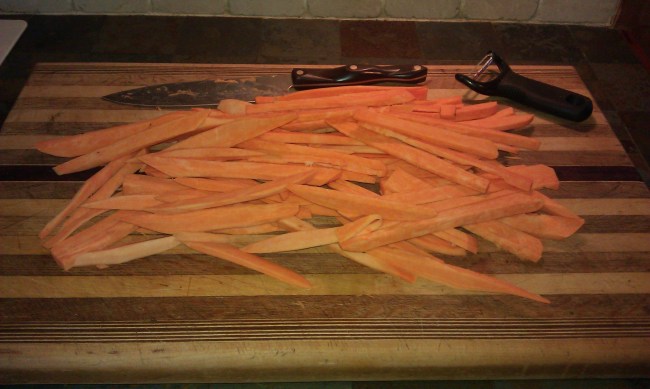
Next, cut them into either wedges or strips.  The thickness will determine the time it takes to bake them.  I like smaller strips, but too narrow and they will burn up.

I made this pile for three of us, with leftovers.

Image

Next, put them in a big bowl and drizzle them with good quality olive oil, and a big pinch of salt.  I always use Morton’s sea salt.  It is thicker ground than regular table salt, and is better for you.  I keep it in a small finger bowl and use my fingers to pinch out how much I need.  A big pinch is about a teaspoon.

Spread the potatoes out evenly on a pan lined with tinfoil.  They tend to stick, and I hate cleanup!

 Image

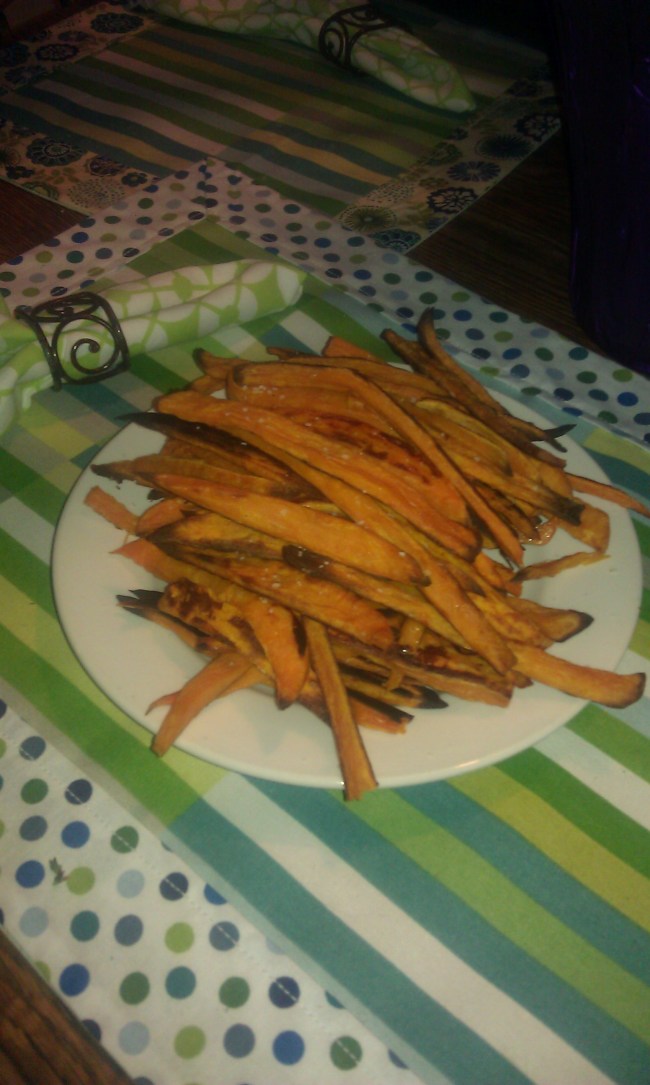
If you have to, use two pans.  Put them in the 500 oven and cook for a while.  You’ll need to check them regularly because the cooking time depends on the oven and the size of the fries.  If you used two pans, make sure you switch their position in the oven every 5 minutes or so.  Mine took about 20 minutes to cook until they were starting to brown and crispy.  When you take them out of the oven, let them cool a few minutes before putting them in the serving dish.  As they tend to stick, using your fingers to pick them off the tin foil is the easiest, so be careful not to burn yourself!  Next, add a sprinkle of salt and serve!  YUM!Image