Pheasant Season

As I’ve mentioned, fall is one of my very favorite seasons, in part because beginning in late October and running through Christmas, Connecticut hosts a hunting season for pheasant.  Throughout the state there are controlled releases of birds on state land at irregular times during the week.  These are then hunted by upland bird hunters, usually with dogs to help them find, or flush, the birds.  Peasant is by far my all-time favorite animal to hunt, and I look forward to the beginning of the season all year.  They not only are a blast to hunt, but they make a delicious addition to the November menu!

Image

I first hunted pheasant, as well as chukar and grouse, with my dad.  I was perhaps in my twenties (I can’t remember because it was SO very long ago!) when he invited me along on a private hunt.  At a private club, the way it works is that when you arrive you determine how many birds you want to hunt, usually 2-4 per person, and the guides will set them out for you in the hunting area.  The birds are raised in huge pens nearby.  You relax for a while and then off you go to find the birds.  We didn’t have our own dogs then, so we used the dogs that came with the guide service.  This may seem to some like an unfair advantage over the birds, but let me assure you it is not.  Pheasant are not like wild chickens.  They are crafty and very fast and can often outsmart a dog by leaving a confusing scent trail, running in circles, or just generally blending into their environment the way God made them.  It is neither easy to find the wily creatures after they are freed nor is it easy to fell them, although I must say that pheasant are slower in the air then the average game bird. That’s one of the reasons I like to hunt them!  I need all the advantage I can get.

Back then with my dad I was an average shot.  I remember missing the first bird, but I got some that day.  Over the years when I lived in Colorado, my husband and I would often head south and east to Blanca in the fall and hunt birds there.  I was never a crack shot, like he was, but I hit most of what I aimed at.  Recently, when we were back in Connecticut, he and I decided to tune up our game by going over to Millbrook  New York and spending the day at the Orvis shooting grounds called Sandanona.   http://www.orvis.com/sandanona  They have a world class sporting clay course for wing shooters.  This was a real treat for us, and not something we could do very often.  100 clays at 20 stations each to practice on.  By the end of the day we had sore shoulders and tired arms, but we were smiling. He was smiling somewhat more than me, as he had schooled me at each station, hitting  approximately 70% of his targets to my somewhat less then 50%.  Needless to say I was a bit discouraged.  So the following Christmas, after a whole bird season of listening to me gripe about what a bad shot I was, my darling husband gifted me a trip to the Sandanona shooting school, where I would be taught the proper techniques and principles of wing shooting in a half day class with an expert.  I couldn’t wait.

The class was super fun, and I learned a ton about how to shoot.  I learned that my gun doesn’t really fit my body.  It’s too short, and canted too little to line up with my eye when I draw it up.  But I love my gun.  My dad gave it to me and I’ll never get rid of it.  I learned that even though I am right handed, I am “left eye dominant”, which means that my left eye leads and my right eye follows.  I learned that because of this I should be shooting left handed.  So I tried that.  It’s like walking with shoes on the wrong feet tied together. Not even safe.  I learned that I could compensate by using a patch over my left eye, to force my right eye to work.  I tried that and actually fell down. With a loaded gun. My shooting went below 30%.  I spent the next season practicing closing my left eye instead of my right while I draw.  Draw, close, aim, fire.  I hit a few birds, but didn’t even make my bag limit for the season.

What now?  I’m trying to get back to a place where I can forget my limitations and just shoot.  Where I can let instinct take over for ability.  I need to un-think shooting.  I’m trying to be OK with the fact that, for whatever reason, I’m just not a very good shot, and I’m trying to remember that even though I love to shoot, what I really love is to walk in the woods on crisp fall days with my husband and my son and my dog.

Here is a recipe for one of our very favorite fall meals.  If you want leftovers, you had better make 2.  It takes a bit of work, but is well worth the effort.  FYI the easiest way to get the meat off a pheasant is to cut the skin of the breast and peel it back, and then filet the breasts off the bone.  Then continue to pull the skin down over the thighs, exposing the legs.  Break the leg joints at the end of the ‘drumstick’ and again at the hip.  Use a knife to separate the legs from the body.

Pheasant Pot Pie

6 cups water

1 pheasant, breasted, and legs skinned

salt and pepper to taste

1 tsp parsley

1 tsp. thyme

1 bay leaf

1 cup diced potatoes

1 cup diced turnips

1 cup diced carrots

1 cup diced leeks

1/2 cup frozen peas

1/2 cup chopped onion

4 tbs butter

3 tbs flour

1-2 bullion cubes

1 pie crust.

In a stock pot, bring the water to boil and add the pheasant and the spices.  Reduce heat to low and simmer the pheasant for 20 minutes or until cooked through.   Allow to cool, reserving the liquid.  Meanwhile, chop the vegetables and mix in a large bowl.  In a heavy cast iron pan over medium heat melt the butter and then add the flour, stirring constantly until the roux begins to darken.  Stir in the bullion.  Add about 1 1/2 to 2 cups of the reserved liquid broth to the roux and stir until you have a smooth gravy.  Freeze the remainder of the broth for future use.  Mix the gravy into the vegetables.  Cut the pheasant into bite sized pieces and mix into the vegetables.  Put all of it into a pie plate or a 9″ round cake pan,mounding to fit.  Cover it all with the pie crust, sealing the edges to the pan.  Bake in a 350 oven for 1 hour.  Serve warm with a nice salad.
Ah Ah Ahhh Asparagus! Bless you.

Springtime for some is a horrible season of allergies.  Stuffy, runny noses, red eyes and sneezing abound as the deciduous and fruit trees blossom and spread their pollen throughout the warming springtime air.  For some, it is a time for Claritin, Allerest, Zyrtec.  What does this have to do with asparagus, you ask?  Not much, except that they coincide, and they were both on my mind after our short trip out to Martha’s Vineyard last weekend.

I have never had seasonal allergies, but my son does.   He gets great purple bags under his eyes and has a terrible grouchy attitude.  So terrible, in fact, that when he was 11 I brought him to the doctor, explaining that he was just a miserable person and what could I do about it?  She took one look at his purple shaded eyes and diagnosed him with seasonal allergies, prescribing a daily dose of Claritin.  It worked marvelously.  His attitude improved, the purple diminished and we went our merry way, but it caused me to wonder about allergies; why some people get them, and what I could do about it for my son.  Over the years I have found some homeopathic remedies that work with varying success.  

Quercetin is a natural substance found in the skin of onions and apples.  Sadly, apples and onions are not seasonal to springtime, but fortunately quercetin is available over the counter as a supplement.   

Stinging nettle, found in many allergy medications, is a useful herb in curbing the annoying symptoms, and can be taken in a tea form.  Stinging nettle is available now, and grows best in weedy lots and near manure piles.  Do not forget your gloves and long sleeves, as well as shoes and socks.  The effects of touching the plant itself are uncomfortable in the extreme.  Chop it, steep it, season it with honey, and enjoy!  If gathering it is too much for you, most health food stores will carry it, but it is best fresh.  

Honey is another supposed remedy for allergies.  It is recommended to take a teaspoon once a day, but the honey must be unblended and from your area in order for it to have a benefit.  Some swear by this, but so far the evidence is inconclusive.  It can’t hurt, anyway.

Acupuncture may help alleviate allergy symptoms, especially if you start treatment about a month before peak season.  Apparently opening certain meridians can help to suppress an overactive immune system.  

Last weekend, as I was indulging in the abundant asparagus that grows in the garden there, that we have patiently waited for years to mature and produce, my son was miserable.  He wanted only to lay inside and play on his Kindle.  He was tired, and grumpy, by turns sarcastic, caustic and irritable.  We couldn’t even get him to enjoy going fishing.  And only later, as I consider writing a post about the lovely asparagus, does the reason occur to me.  Duh! What is it about mothers who are always the last to figure it out?  I really should have known.

So.  To the asparagus!  

Any aficionado of that strange plant will tell you with fervent belief that fresh cannot compare to store bought asparagus, and we are right.  The ONLY time to eat it is when those tender shoots get to be just the right height to cut, and there are just enough to take without killing off the plant.  Harvesting asparagus is an exercise in patience.  A strong asparagus plant will send out shoots when the weather warms, but you must not cut those first delectable morsels!  They taunt you as they harden into stalks, but in order for the plant to thrive it must have foliage to photosynthesize. Those first stalks are necessary to the plant’s health, and only after they begin to mature and more shoots emerge may one gently cut and enjoy some of the delicate stalks.   The flavor is sublime.  Below are some of the ways we indulged our culinary fantasies and savored this most precious springtime treat.

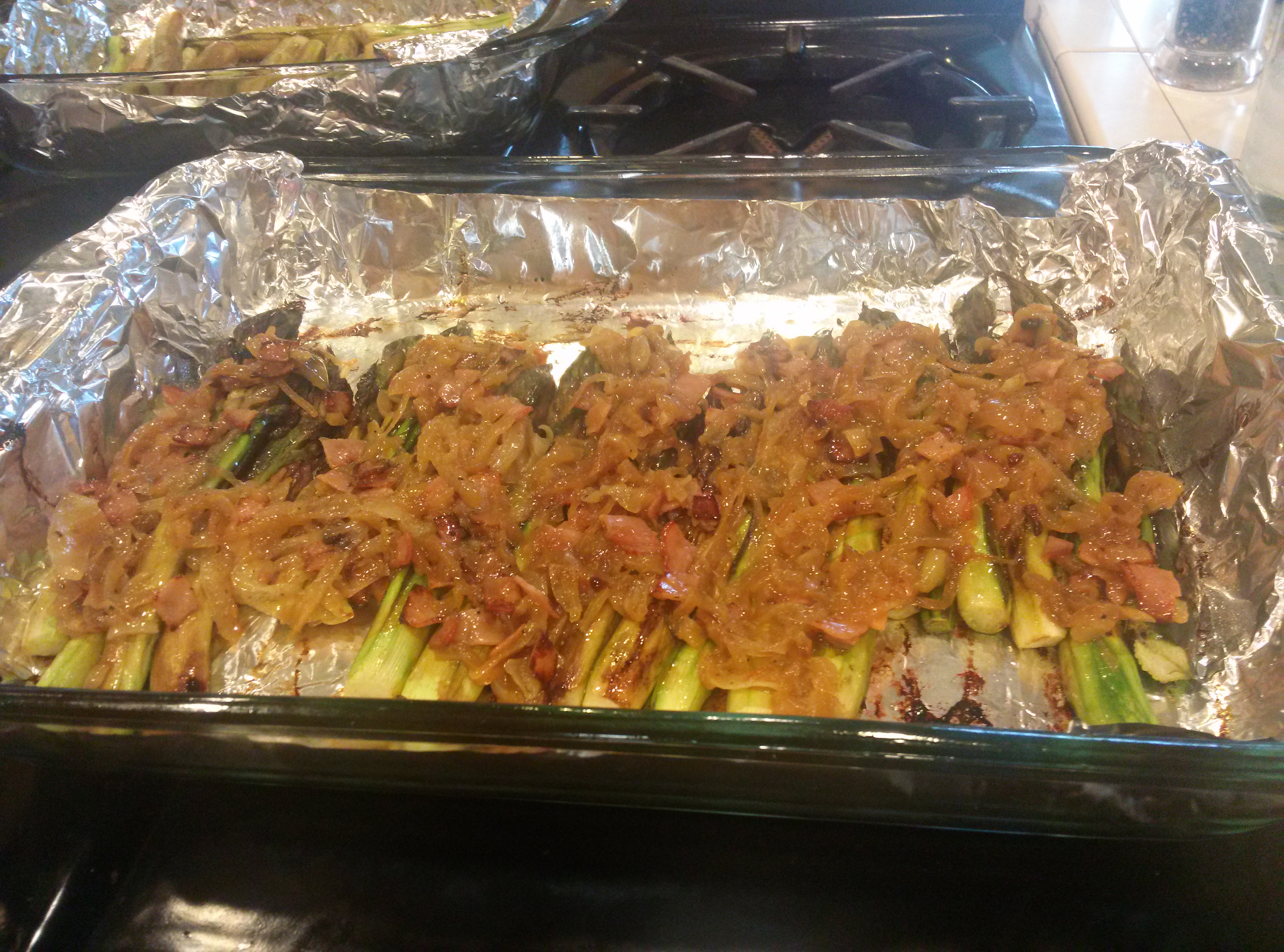
Roasted Balsamic Asparagus with pancetta and caramelized onion

Oven temp 400.

2 lbs of fresh cut asparagus, peeled if the outer skin is tough.

4 tbs olive oil, divided

3 tbs good balsamic vinegar

2 large onions 

1/4 lb. pancetta. Ham, prosciutto, or bacon would work as well.

Chop onions in half and slice thinly   Chop pancetta into small squares.  In a skillet heat 2 tbs. oil on med heat.  Stir in onions and cook, allowing to brown.  When onions are almost done, about 15 minutes, add pancetta and cook, stirring, for 5 more minutes.  Meanwhile, place asparagus in a single layer in a roasting pan lined with tinfoil and coat with the remaining 2 tbs oil.  Sprinkle with the balsamic and roast in 400 F oven for about 20-30 minutes, depending on the thickness of the asparagus.  Remove, top with hot onion and pancetta mixture and serve.  

Image


Asparagus Yorkshire Pudding

Oven temp 400 F

3 eggs

1 1/2 cup organic flour

1 1/2 cup organic or raw milk

Salt to taste.

1/3 cup roast drippings, bacon fat or lard.

1 lb asparagus

Peel Asparagus if necessary.  Place a roasting pan in hot oven for 5 minutes.  Meanwhile, mix together first 4 ingredients into a batter.  When the pan is hot, add the drippings or bacon fat and coat the pan.  Place the asparagus in a single layer and cover with the batter.  Return to the oven and bake for about 20 minutes, then lower temperature to 350 degrees and bake an additional 10 – 15 minutes or until pudding is puffy, lightly brown and beginning to crisp.  Refrain from opening the oven until you remove the pudding.  If you must check the progress, use the light and window.   Allow to cool for a few minutes and cut into squares.  Serve immediately.


Kitchen Essentials and Venison Sausage

Eating locally and seasonally in Connecticut is a hard task unless you plan ahead.  Making things and storing them for future times is essential to a happy cook and a well-stocked kitchen.  In order to put up produce and meat, sauces and fruits, I have some essentials in my kitchen that I could not live without.  Below you will find a list of must-haves for preparing for leaner times. 

Freezer

I can’t say enough about investing in a good chest freezer.  The simplest way to store meat, vegetables, and fruit is to freeze them as soon as possible after picking or harvesting.  It maintains the vitamins and nutrients far better than canning or other methods, and in most cases keeps the food safe for months or even years.  It is the easiest and fastest way to put up a harvest at its freshest, and to store produce for the winter months.  I have a deep chest freezer that I bought new from Sears for about 350.00, and I store thousands of dollars’ worth of fresh meat and vegetables in it every fall to last through the winter months.  If you don’t have one, don’t want to incur the cost of a new one, there are several online sites where you might shop for a used one for much less.  So much of the excess produce from my kitchen garden goes into the freezer right after picking, and it is such a delight to browse the shelves for a cooking idea knowing that my choices are ripe, delicious, healthful, and clean.    

                Canning pot or Pressure cooker.

A canning pot is a lovely thing to have, and very useful for storing jellies, sauces, broth, fish, and some veggies.  Not all veggies are suitable for canning fresh, so we can mainly prepared foods, like chili and tomato sauces, sweet butters and jellies and cooked vegetables like sauerkraut.  We use ours most often during the fall months when we make and can sweets and sauces to give as gifts during the holidays.  We also jar hot sauces and pickles of all sorts, chilies, beans, corn and tomatoes.  If you lack a proper canning pot, take some time to look for one at your local thrift or consignment store, where they can often be picked up for a few dollars.  Without one, you can still make many canning recipes in a regular sturdy pot.

                Juicer

I love my juicer.  It was given to me by a dear friend who lived off the grid.  He had a generator for electricity, but every time he tried to juice he would blow a fuse.  When he parted with the juicer, he made me promise to make him juice anytime he came to visit, and even though he still lives at about 10,000 feet, deep in the mountains of Colorado, with no phone,  I’m still waiting to make good on my promise.  The juicer is a Champion, and very old and outdated.  It is essentially a big motor connected to a shaft that drives a shredder and some plastic implements to strain the juice, but it will juice anything.  I could put a potato in and get potato juice.  I use it for fresh fruit and veggie juice during the summer months, (carrot beet apple is my favorite) and in the fall I juice leftover kale and spinach, freeze the juice and add it to soups and stews during the winter to add flavor and green nutrients. 

                Dehydrator

Anyone can use their oven for a dehydrator, but it’s just so quick and easy to use one made for the purpose that this is on my list as well.  With the dehydrator there is no need to turn the produce, as it gets evenly dry in a much shorter time than using the oven.   We use ours to dry fruit for snacks, beef jerky, dried fish to be used in soups, and most especially mushrooms.  Dried and then frozen, mushrooms can be stored for years in the freezer, but they never make it that long.  Wild mushrooms are a treasure and  we hoard them in season and use them sparingly for the rest of the year.  I’m learning more and more about the wild world of fungi and I’m excited for a season of mushrooming this summer and fall. 

                Grinder/sausage maker

When you hunt or gather the majority of your own protein, having a grinder is a blessing.  Meatloaf, hamburgers, hash, and meatballs all require the meat to be finely ground.  The added benefit is, with a small attachment, ground meat can be stuffed into casing to make delicious sausage!  I love venison sausage, and many of our friends and family have come to love it as well.  It’s one of the things we give as gifts during the holidays and it is always well received.  My husband makes a garlic cheddar sausage that is mouth-wateringly good.  The recipe follows.

                Cheddar Garlic Venison Sausage

4 Lbs. Venison, ground fine

1 ¼ Lb. Pork fat, ground fine

8-10 cloves garlic, chopped fine

½   Lb. Cheddar cheese

2+ Tbsp. Crushed red pepper, depending on your spice tolerance

½ cup white wine

2 Tsp. Sugar

1+ Tbsp. coarse ground Black pepper

1 Tbsp. salt

5 feet medium sausage casing (you can get this from a butcher).

 Mix the fat and meat together and then mix in the remaining ingredients.  Mix by hand until everything is uniform.  Stuff the casings with the mixture into 4 to 5 inch lengths.  Allow to settle in the fridge for a day or two, to allow the flavors to blend.   Cook in water or stock, on a grill or pan fry over medium low heat.  These can be used like any sausage, served alone or with pasta, in a salad, or on sandwiches.  They freeze remarkably well.   Try substituting any game meat.  We made them with caribou once and they were just as delicious.

Local, Sustainable, Healthful and Clean

Whenever I consider eating something, I try to stick to some basic rules.  Each one is not hard and fast, and I do tend to make some exceptions, but I try to stick to them most of the time to ensure that my diet stays at least relatively healthful, wholesome and environmentally sound.  My rules are that the majority of what I bring into the kitchen and eat should be from local sources, sustainable, healthful and clean, and by doing this each time I shop or prepare, I know I’m making good choices for myself and my family.

Questions to ask yourself.

Did I grow/harvest/collect/hunt or fish this?

If it came from my garden, or I got it in some other way and know its source, I know it is good for us. Ideally you should be able to answer yes to this question most of the time.

 Could I have grown this?

Maybe I didn’t grow it, but it is something that I could have grown if I had the time/space/energy.  This is a dangerous one because lots of things might have been grown locally, but were in fact planted with genetically modified seed, sprayed with toxins, picked before their prime by exploited workers, packed in non-renewable packaging, and trucked from 1000 miles away, like most veggies we find in the store.  If it passes the “I could have grown it” question, see below.  Anything from a farmers market should answer yes to this question.

 Did it come from my area?

Is it something that has been eaten in season by people from your area for eons? If it’s a kiwi in December, and you don’t live in the tropics, you might want to put it back.

 Did someone I know make this?

This is a good test, and an easy one.  It is a pleasure to answer yes to when you have something special, like a gift of honey, or fish.  If you know who got it and where, it’s probably safe.

 Is it fresh/clean/organic?

Has it been polluted in any way? Is it rotten?  Poisonous?  Has it been cleaned properly? This question rules out lots of stuff in the supermarket.  Most produce items have been treated with pesticides or other chemicals.  Organic is a good choice, but not always enough.   This question also pertains to things you might hunt, fish or gather for yourself, like mushrooms, squid, or rabbit.  I will emphasize that all gatherers should have knowledge about what they are seeking and how to collect and clean it properly.  That is one benefit of technology today.  All the information we need is at our fingertips.

 Is it seasonal?

Most fresh foods should be in season before you decide to put them on your menu.  While there are a multitude of ways to store fresh produce and staples for later times, if you will be eating it fresh, you want to make sure it is in season.  It is one way to insure that it doesn’t come with too high of a carbon price. 

Exceptions

Olive oil is a must in our house, and we try to choose extra virgin organic oil.  For important information on olive oils, check out http://www.truthinoliveoil.com/ The book Extra Virginity has some shocking information.  A must read for olive oil lovers. 

Nuts are another staple.  Almonds, especially, are very beneficial to health, so we usually keep a supply of them in the house.  Good, fairly inexpensive nuts can be found at Trader Joe’s.  

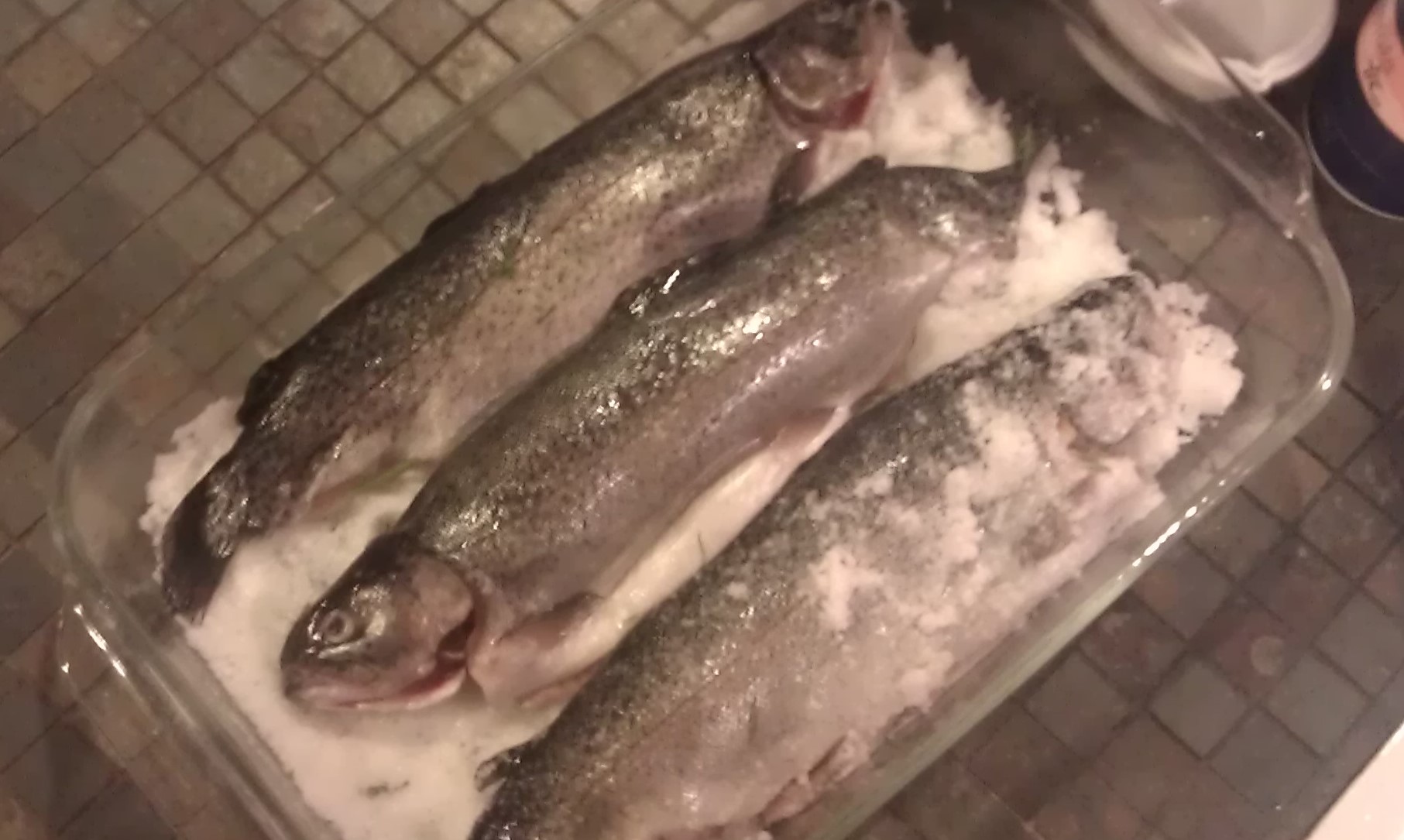
Salt and spices.  Every kitchen need a good supply of fine herbs and spices, and I only grow herbs.  For salt I always use Norton’s coarse kosher salt or natural sea salt, never table salt.  Here is a photo of Trout baked in Salt.  Coated entirely, the salt makes a crust that can be cracked off.  For the recipe, see here: http://www.foodnetwork.com/recipes/mario-batali/whole-fish-baked-in-salt-crust-recipe/index.htmlImage

Today I am out to hunt the abundant cattail root.  A delicacy in spring, and a staple for the summer, cattails grow wild in any swampy area throughout New England.  The roots are mild and can be eaten raw, while the new shoots, paired down to reveal the white inner parts, are similar to leeks.  Sauteed with butter and salt, they make an excellent side dish. 

Happy Eating!


What’s for dinner in April?

It’s all well and good to say you eat locally in August, when the bounty of the harvest is just falling out of the garden, but when the cool winds blow through the months of spring, and nary a sprout is available at your local farmers market, if it is even open, what do you eat then?  Daffodils?  Grass?  Here I’ll give you some examples of what truly is available that fits the bill for Local, Seasonal, Sustainable, and you can feel good about what you put on the table.

Spring is the season for cod fishing, and if you live on the Atlantic shore, or anywhere in the North East, fish caught off the Connecticut Rhode Island and Massachusetts coasts are considered local, especially if you catch it yourself!  “What?!” You ask?  Relax.  It’s easier than you think.  Many charter boats go out regularly for cod, and provide you with the bait, tackle and knowledge to fish on your own.  A Google search will help you find one nearest you and the times and dates they fish.  The best part is you might come home with many pounds of cod for the freezer or dehydrator, and with luck you’ll have enough for many suppers to come.  Cod freezes remarkable well, and as it is a firm fish, holds its texture and flavor even through vigorous cooking techniques such as stews and casseroles. Try fresh sauteed cod with saffron risotto, or perhaps baked cod with cream, leeks (you might find leeks overwintered) and new spring green onions.  If you look for cod in the supermarket, ask if it is caught locally, and with rod and reel (line caught).

It’s also turkey season in Connecticut, and many a hunter is anxiously awaiting opening day.  This year my husband has to miss the beginning of the season, and my son, an avid pre-hunter, has asked me to take him out.  Having never turkey hunted before, this is somewhat of a daunting request.  We’ll see how it actually goes.  It would be a miracle if I actually got a spring turkey.  Other good protein sources would be chicken, venison, grass fed local beef and rabbit.  The chickens are starting to lay again with the warmer and longer days, so eggs are always a good choice.  A nice quiche is a perfect light spring meal, especially with sauteed garlic scapes.  Scrambled eggs with local goat cheese, roasted garlic and baby spinach would be delicious.

As for dry goods and staples, this morning I had polenta made from cornmeal purchased from Young Farm in East Granby Ct.  It is called Canada yellow flint cornmeal, and it is stone ground the traditional way.  The corn it comes from is New England open pollinated heirloom variety flint, an “antique” corn that has much higher nutritional value than corn harvested with conventional methods as per agri-business in the Midwest.  Young farm is an exceptional company that produces delicious and nutritious, not to mention sustainable and morally acceptable corn and wheat products, as well as vegetables.  Lean more about Young Farm here.  http://www.farmfresh.org/food/farm.php?farm=2752#profile.  The polenta, with a spot of honey and some of last year’s frozen blueberries, was a fabulous start to the day. We eat it with salt, pepper and butter and a sprinkle of Parmesan when we want something savory instead of sweet.

“Vegetables?”, you ask. Not many, to be sure, but some.  I have started a variety of lettuce in my bathtub, so I can add some micro-greens to whatever organic lettuce I buy at the market.  I have had basil growing in pots since January and that always adds a bright spring flavor to any dish.   Kale seems to be always available, as it lasts throughout the winter.  Cabbage and sweet potatoes, carrots and onions are also over-winterers in the root cellar.  Garlic scapes are coming out of the ground now and it’s almost time for the luscious asparagus shoots, the star of spring.  I have frozen peas and spinach and tomatoes from last year’s harvest and even some acorn and butternut squash.  A lovely squash, kale or spinach soup with some flat bread makes a lovely spring meal. IMAG0262.jpg

As for fruit, we have our trusty freezer with its dwindling supplies of frozen blueberries, peaches and strawberries.  Not fresh, but still great for smoothies and the occasional pie.  I can’t say enough about investing in a good chest freezer.  The simplest way to store meat, vegetable, and fruits is to freeze them as soon as possible after picking or harvesting.  It maintains the vitamins and nutrients far more than canning or other methods, and in most cases keeps the food safe for months or even years.  It is the easiest and fastest way to put up a harvest at its freshest, and to store produce for the winter months.  I have a deep chest freezer that I bought new from Sears for about 350.00, and I store thousands of dollars’ worth of fresh meat and vegetables in it every fall to last through the winter and spring months.  If you don’t have one, or can’t afford a new one, there are several on-line sites where you might shop for a used one for much less.  So much of the excess produce from my kitchen garden goes into the freezer right after picking, and it is such a delight to browse the shelves for a cooking idea knowing that my choices are ripe, delicious, healthful, and clean.

Last night we had grilled marinated venison with sauteed onions.  It was simple, and simply delicious.   I used a shoulder roast and just sliced it into half inch steaks, mixed it with salt, pepper, olive oil and good balsamic vinegar, left it in the fridge of a few hours and grilled it over high heat.  Quick and easy.IMAG0260.jpg

IMAG0261.jpg

Contrary to popular myth, venison, if well treated and well prepared, is neither gamy nor tough.  While it has an unmistakable rich flavor altogether different than beef, it is a succulent and delicious addition to our menu.  Miss-treated it can be an awful chore to eat, and I am reluctant to eat venison unless I personally know the hunter and the manner in which it was killed and dressed. More about venison in particular and hunting in general later.  Happy spring!

The speed of life: how we relate to our food.

Time sure flies, doesn’t it?  How did I get this old?  I look in the mirror and am amazed that inside I still feel  twenty six, but outside I look every bit of my forty (uh…) ish years.  And it keeps getting faster and faster.  I’ve satisfactorily explained this phenomenon to myself in terms of a mathematical theory involving ratios. It works like this. The amount of time we have been alive is directly proportional to the speed of time.   So in my head I understand it, but in my heart it’s still a mystery.  Why does time fly?  Why can’t I slow it down?

It seems to get worse the older I get.  This should be obvious as per my theory, but I believe it is also related to our new love/hate relationship with technology.  I mean, one hundred years ago, and for ages before that, when you needed to speak to someone who lived far away, you wrote them a letter.  And then you waited hopefully until they responded by mail to hear their reply.  Often the mail was at the whim of weather or war, and depending on how far away they were, you might wait weeks or months to hear from them.  Fifty years ago you picked up the party line and politely asked the operator to connect you through to whomever you were trying to reach, and hoped that Mrs. Miller from down the street  was not only not using the phone, but that she wouldn’t listen in on  your conversation.  And then you waited till they came to the phone.  Now what?  If someone doesn’t respond to your text within a few minutes, it’s not only bad form, but it’s highly irritating.  You might even feel like you are being ignored. How dare they!  Humph!

Technology has cracked our world open and united us in ways we haven’t begun to understand.  We have more immediate access to anything on the planet than ever before in the history of mankind.  Information, ideas and products are all at our fingertips in seconds, or in our homes within a matter of days.  This brings with it a host of reactions; socially, biologically, functionally, economically and emotionally.  Good for us, on many levels, but bad for us, I think, in more ways than one.

The way in which it concerns me, and what I attempt to address, is the way in which we are related to our food.  What and how we eat has changed more in the last one hundred years than it has changed in the last 5 million years.  And that is affecting who we are, what we do and how we feel.  It would be absurd to assume that biological evolution can keep up with the speed of technological evolution.  Eighty five million years of walking upright and we are essentially the same size and shape.  We eat, we poop, and our organs function in much the same way.  Yet in only 30 years our sociological environment has changed so fast that our bodies can’t keep up.   We are already learning that listening to noise with ear buds can alter the development of the growing ear drum, and that typing on a computer keyboard for hours a day can destroy the finely made insides of the carpel tunnels in our wrists.  We know that spending too much time looking at small print materials will negatively affect the shape of our eyeballs and that breathing particulates from certain manmade toxins will cause lumps to grow in our lungs.  The way we relate to our environment, as a culture, is harming us.  And yet we continue to assume that all food is good food, and the more the better.

The government isn’t helping us, either.  The Food and Drug Administration has taken on the role of dietary counselor for the nation, and they seem to be the last ones to get on board with healthy trends.  While they are currently advocating more whole grains and lower fat, which is good on some levels, they refuse to address the issues of where our food comes from, what is hidden in it, and how it was produced.

I am not a doctor, a nutritionist or even a dietitian, and lay claim to no professional insight into the working of human metabolism, agribusiness, food economics or any other thing.   My techniques, theories and insights are based on common sense and basic civic morality, as well as my experience cooking with whole, natural and healthful foods.  This blog is an introduction to moral, healthful eating and a place to start on the journey to become responsible for the things we put in our mouths.

There are plenty of very detailed books that explain how sugars, proteins and carbohydrates work in the body, describe which nutrients are best for us and why.  There are insightful books that explain in detail the multitude of reasons we should eat mostly food from our own area.   There are many books and documentaries that show how and why the American meat industry is bad for America, bad for Americans and downright disgusting and immoral.   All of these should be explored and internalized when choosing a method for your style of eating.   I hope here to lend support to a method that is based on the principles of eating locally, eating seasonally, and therefore living sustainably.  Look for more about these issues, and recipes that support them,  in the weeks that follow.